 |
|||

Best viewed in
Back to
|
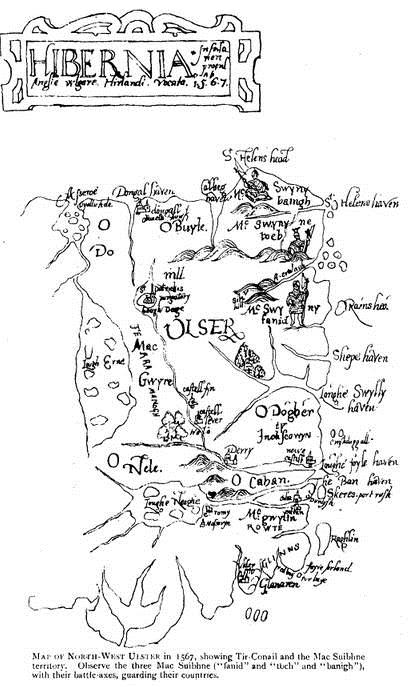
They divided into three branches: Mac Suibhne Fanad, Mac Suibhne na d'Tuatha and Mac Suibhne Banagh. Fanad (official name: Fánaid) is a peninsula that lies between Lough Swilly and Mulroy Bay on the north coast of County Donegal in Ireland. The origins of the name Fanad are lost in time though there is some speculation that the name derives from an old Gaelic word Fana for "sloping ground". It is also referred to as Fannet, Fanid, or Fannett in older records. Rathmullan was the seat of the Mac Sweeney Fanad for the next 400 years, during which time their influence extended from Donegal into Connacht and Munster. In Donegal their principle seats were Doe Castle and Rahan Castle near Killybegs. All three of the Mac Suibhne clans were victims of Oliver Cromwell’s invasion of Ireland in the 16th century. They could not compete with the military strength of Cromwell and had their land taken and given to British settlers.
The name Mac Suibhne evolved into the more English sounding MacSweeney as the British integrated themselves into Irish society. The name then changed further, dropping the ‘Mac’ prefix. People did this because it was difficult to find work if you had an Irish sounding name. The more English sounding Sweeney would have offered a better chance.
Thousands of Sweeneys left Ireland for Britain, American and Australia during the ‘Great Famine’ in the mid-19th century. It is now a popular name around the world.
|
||